
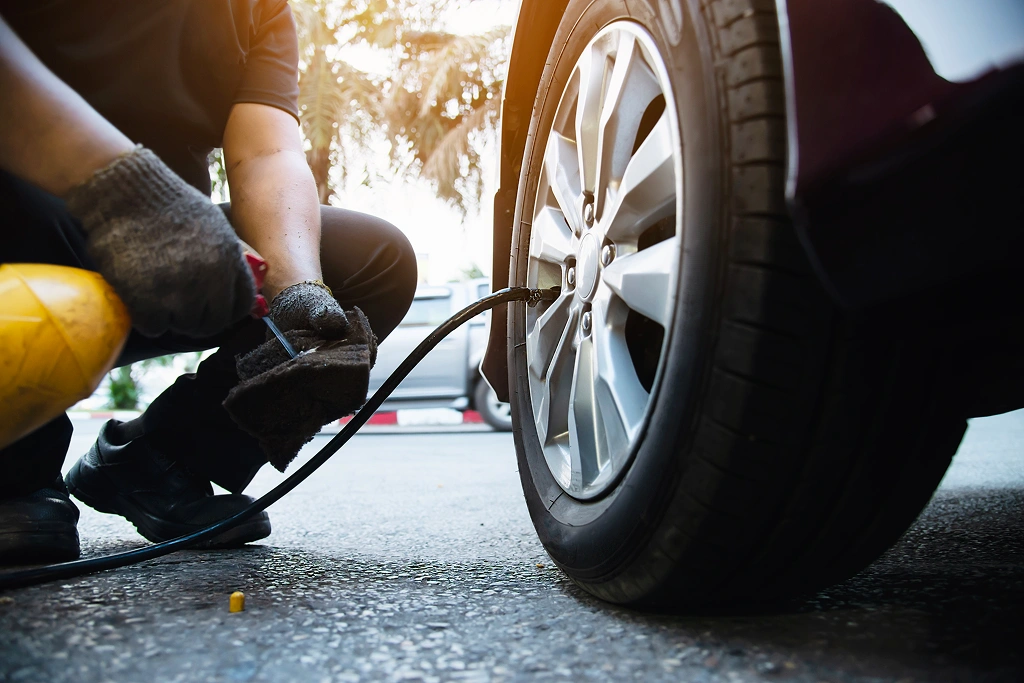
Most drivers view tires as “set and forget” components, only checking them when a warning light appears or a flat occurs. However, your tires are the only point of contact between your vehicle and the road. Their internal pressure dictates the shape of that contact patch, which in turn influences everything from your monthly fuel bill to your car’s ability to stop in an emergency.
Maintaining the correct tire pressure is the single most cost-effective “tweak” you can perform on your car. It requires no specialized tools and costs almost nothing, yet it provides immediate returns in both safety and savings.
The Physics of Rolling Resistance
To understand how pressure affects fuel consumption, you have to understand “rolling resistance.” When a tire is under-inflated, it flattens out against the pavement. This increased surface area creates more friction and requires the engine to work harder to move the vehicle.
Think of it like riding a bicycle with soft tires; you have to pedal much harder to maintain the same speed. In a car, this extra “pedaling” comes from burning more fuel. According to the Department of Energy, for every 1 PSI (pound per square inch) drop in pressure for all four tires, you lose approximately 0.2% in fuel economy. While that sounds small, many drivers are unknowingly driving with tires 5 to 10 PSI low, which can lead to a 2% to 5% increase in total fuel costs over a year.
Safety and Braking Distance
While fuel economy is a matter of the wallet, tire pressure is also a matter of life and death. An under-inflated tire does not distribute weight evenly across the tread. Instead, the weight is pushed to the “shoulders” or edges of the tire. This causes the sidewalls to flex excessively, generating intense heat that can lead to a sudden blowout at highway speeds.
Furthermore, tire pressure directly impacts your stopping distance. A tire that is not properly inflated cannot maintain a consistent grip during hard braking. In wet conditions, an under-inflated tire is much more likely to “hydroplane,” where a layer of water builds up between the rubber and the road, causing you to lose all steering control.
The Problem with Over-Inflation
If low pressure is bad, is high pressure better? Not necessarily. Some drivers over-inflate their tires thinking it will further increase fuel economy. While it does reduce rolling resistance slightly, it creates new problems.
An over-inflated tire becomes “rounded” like a bowling ball. This reduces the contact patch to just the center of the tire. This leads to a harsh, bouncy ride, increased wear on suspension components, and—most importantly—reduced traction. Because less rubber is touching the road, your braking distance actually increases, and the tire is more susceptible to damage from potholes or road debris.
Seasonal Fluctuations: The 10-Degree Rule
Many drivers are surprised to see their tire pressure light come on during the first cold morning of autumn. This isn’t usually due to a leak; it’s physics. Air density changes with temperature.
As a general rule, for every 10-degree Fahrenheit drop in temperature, your tires will lose approximately 1 PSI of pressure. Conversely, they will gain 1 PSI when the temperature rises by 10 degrees. This is why it is vital to check your pressure at the change of seasons. A tire that was perfectly inflated in July could be dangerously low by November.
Practical Insights: Finding the “Magic Number”
A common mistake is looking at the number printed on the side of the tire itself. That number (e.g., 50 PSI Max) is the maximum pressure the tire can safely hold, not the recommended pressure for your car.
To find the correct number, look for the “Tire and Loading Information” sticker located on the driver-side door jamb. This number was calculated by the car’s engineers to balance fuel efficiency, ride comfort, and safety. Always check your pressure when the tires are “cold”—meaning the car has been sitting for at least three hours or has been driven less than a mile. Driving generates heat, which expands the air and gives a falsely high reading.
Summary
Checking your tire pressure once a month is a five-minute habit that pays for itself. Proper inflation ensures that your tires wear evenly, lasting thousands of miles longer, while simultaneously keeping your fuel consumption at its lowest possible level. Most importantly, it ensures that when you hit the brakes in an emergency, your tires have the optimal grip to bring you to a safe stop.
